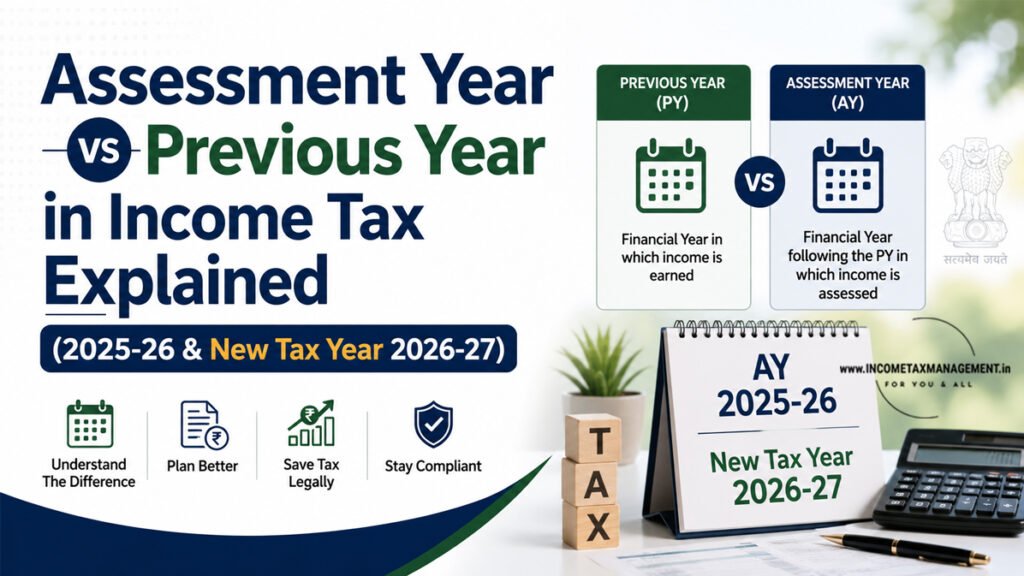
Confused Between Assessment Year Vs Previous Year? Learn The Difference With Simple Examples, Plus How The New Income Tax Act 2025 Replaces Both With Tax Year From April 2026.
Have you ever stared at your income tax return and wondered why you are filing for “Assessment Year 2026-27” when you actually earned the money in 2025-26?
You are not alone. Millions of taxpayers in India find this dual-year system confusing every single year. But here is some good news: the government has finally heard your frustration. The Income Tax Act, 2025 introduces a brand-new concept called “Tax Year” that replaces both Assessment Year and Previous Year starting April 1, 2026.
In this guide, we will break down exactly what Assessment Year and Previous Year mean under the current law, how they differ, and what the new Tax Year means for your future filings.
What Is Assessment Year (AY)?
The Assessment Year is the twelve-month period in which the Income Tax Department evaluates your income and collects tax. Section 2(9) of the Income Tax Act, 1961 defines it simply as “the period of twelve months commencing on the 1st day of April every year.”
Think of it this way: the Assessment Year is when the taxman knocks on your door to check what you earned last year.
For example,
if you earned your salary between April 1, 2025, and March 31, 2026, the tax department will assess that income in the Assessment Year 2026-27. This period runs from April 1, 2026, to March 31, 2027.
Key Features of Assessment Year:
- It always follows the Previous Year.
- It runs from April 1 to March 31.
- It determines your tax return filing deadline.
- It decides which tax rates and deductions apply to your income.
- The Income Tax Department uses it for scrutiny, refunds, and appeals.
What Is Previous Year (PY)?
The Previous Year is the actual period in which you earn your income. Section 3 of the Income Tax Act, 1961 calls it “the year in which income is earned.” For most people, this is the standard financial year from April 1 to March 31.
Here is the simple rule: the Previous Year is when you make the money. The Assessment Year is when you pay tax on it.
So if you received your salary, rent, or business profits between April 1, 2025, and March 31, 2026, that period is your Previous Year 2025-26.
Key Features of Previous Year:
- It is the financial year immediately before the Assessment Year.
- It covers April 1 to March 31 for existing taxpayers.
- For new businesses, it starts from the date of setup until March 31.
- Since Assessment Year 1989-90, every taxpayer must follow the April-March cycle.
Assessment Year vs Previous Year: The Key Difference
Let us clear the fog once and for all. The table below shows exactly how these two terms differ.
| Feature | Previous Year (PY) | Assessment Year (AY) |
| Meaning | Year when income is earned | Year when income is taxed and assessed |
| Time Period | April 1 to March 31 | April 1 to March 31 (next year) |
| Example for 2025-26 | April 1, 2025 – March 31, 2026 | April 1, 2026 – March 31, 2027 |
| Governing Section | Section 3 of IT Act, 1961 | Section 2(9) of IT Act, 1961 |
| Who Uses It | You (to report earnings) | Tax Department (to assess tax) |
| Filing Activity | You earn income here | You file ITR here |
For Example:
Ravi earns ₹8,00,000 as salary between April 2025 and March 2026. His Previous Year is 2025-26. He files his return and pays tax on this amount in Assessment Year 2026-27.
Why Does India Use Two Different Years?
You might wonder why we cannot just use one year like many other countries. The answer lies in history and administration. When the Income Tax Act, 1961 was drafted, the government needed time to collect information, verify income sources, and process returns. The gap between earning and assessment allowed the tax department to:
- Collect TDS data from employers and banks.
- Match your income declarations with third-party records.
- Give you time to gather documents and compute taxes accurately.
- Apply the correct tax rates announced in the Union Budget.
However, this system created endless confusion. New taxpayers often selected the wrong year while filing returns. Even seasoned professionals sometimes mixed up deadlines because of the dual terminology.
Special Cases: When the Rules Change
The general rule is simple: income earned in the Previous Year is taxed in the Assessment Year. But the law recognizes three important exceptions where income is taxed in the same year it is earned.
1. Non-Resident Shipping Businesses (Section 172)
If a non-resident operates a shipping business in India, the tax is collected before the ship leaves the port. The income is taxed immediately in the same year.
2. Persons Leaving India Permanently (Section 174)
If someone decides to leave India for good, the tax department cannot wait for the next Assessment Year. The income is assessed and taxed in the same year of departure.
3. Discontinued Businesses (Section 176)
When a business shuts down mid-year, the tax department assesses the income immediately. The Assessing Officer can demand a return within the same financial year.
For Example:
Priya closes her boutique on June 30, 2025. Instead of waiting until AY 2026-27, the tax department can assess her income from April 1, 2025, to June 30, 2025, right away.
How This Works for Different Taxpayers
Salaried Employees
If you earn a salary, your employer deducts TDS every month. Your Previous Year is the financial year in which you worked. You file your return in the next Assessment Year. The Form 16 your employer gives you clearly mentions both years.
Business Owners and Professionals
For existing businesses, the cycle is the same as salaried employees. But if you start a new business on, say, December 1, 2025, your Previous Year runs from December 1, 2025, to March 31, 2026. You will still file in Assessment Year 2026-27, but your income covers only four months.
For Example:
Amit starts a digital marketing agency on July 15, 2025. His Previous Year is July 15, 2025, to March 31, 2026. He files his first return in Assessment Year 2026-27.
The Big Change: Tax Year Replaces AY and PY from April 2026
Here is the most important update you need to know. The Income Tax Act, 2025 was passed by Parliament on August 21, 2025, and it becomes effective from April 1, 2026. This new law replaces the Income Tax Act, 1961 entirely and introduces one simple term: Tax Year.
What Is Tax Year?
A Tax Year is a period of twelve months beginning on April 1 and ending on March 31. It replaces both Previous Year and Assessment Year. From now on, you will file your return for the same year in which you earned the income.
For Example:
Under the new law, income earned from April 1, 2026, to March 31, 2027, will be called Tax Year 2026-27. You will file your return for Tax Year 2026-27. No more confusion about two different years.
Why Did the Government Introduce Tax Year?
The dual-year system caused constant confusion. First-time taxpayers often asked: “Why am I filing for 2026-27 when I earned money in 2025-26?” The new system removes this mental gymnastics entirely. According to the Central Board of Direct Taxes, the change aims to improve clarity, reduce compliance errors, and align India with global tax practices.
Old System vs New System: A Quick Comparison
| Element | Income Tax Act, 1961 (Till March 2026) | Income Tax Act, 2025 (From April 2026) |
| Income Period | Previous Year | Tax Year |
| Assessment Period | Assessment Year | Not used |
| Terms Used | Two terms (PY + AY) | One term (Tax Year) |
| Filing Reference | AY 2026-27 for PY 2025-26 | Tax Year 2026-27 |
| Total Sections | 819 sections | 536 sections |
| Total Rules | 511 rules | 333 rules |
Transition Timeline: What Happens and When?
The transition is smooth and well-planned. Here is exactly what you need to know.
April 1, 2025 – March 31, 2026 (Current Period)
Your income during this period is your Previous Year 2025-26. You will file your return in Assessment Year 2026-27. The old Income Tax Act, 1961 still governs this period completely.
April 1, 2026 – March 31, 2027 (New Period)
This is Tax Year 2026-27 under the new Income Tax Act, 2025. You will earn income, pay advance tax, and file your return all under the same label. No more Previous Year or Assessment Year.
For Example:
If you earn salary from April 2026 to March 2027, you will simply say: “My income for Tax Year 2026-27 is ₹12,00,000.” You will file your return for Tax Year 2026-27 by the due date.
Will Old Assessments Become Invalid?
No. The government has made this crystal clear. All assessments, appeals, refunds, and pending proceedings for years before April 1, 2026, will continue under the old Income Tax Act, 1961. Your old tax records remain fully valid.
For Example:
If your assessment for AY 2023-24 was completed under the old Act, it stays valid forever. Even after April 2026, you can file an updated return (ITR-U) for AY 2026-27 under the old law if needed.
Practical Scenarios: Real-World Examples
Let us look at some everyday situations to make this crystal clear.
Scenario 1: Salaried Employee (Old System)
Meera works as a software engineer. She earns ₹15,00,000 between April 1, 2025, and March 31, 2026. Her employer deducts TDS monthly. She receives her Form 16 by June 2026. She files her ITR for Assessment Year 2026-27 by July 31, 2026.
Scenario 2: New Business Owner (Old System)
Rahul opens a café on October 1, 2025. His Previous Year runs from October 1, 2025, to March 31, 2026. He earns ₹4,00,000 in these six months. He files his first return in Assessment Year 2026-27. His tax year covers less than twelve months, but the Assessment Year remains the full April-to-March period.
Scenario 3: Salaried Employee (New System from 2026)
Starting April 2026, Meera earns ₹18,00,000 between April 1, 2026, and March 31, 2027. She now says: “My income for Tax Year 2026-27 is ₹18,00,000.” She files her return for Tax Year 2026-27 by July 31, 2027. One year. One name. Simple.
Why Understanding This Matters for Your Tax Filing
Selecting the wrong year while filing your ITR is one of the most common mistakes taxpayers make. If you choose Assessment Year 2025-26 instead of 2026-27, your return might get rejected or mismatched. Understanding the difference saves you from:
- Late filing fees under Section 234F (₹1,000 to ₹5,000).
- Interest charges on delayed tax payments.
- Mismatch notices from the Income Tax Department.
- Delays in receiving your tax refund.
Key Deadlines You Must Remember (AY 2026-27)
Here are the critical dates for the current Assessment Year 2026-27 under the old Act:
| Deadline | Date | Penalty for Missing |
| ITR Filing (Non-Audit) | July 31, 2026 | ₹5,000 fee (₹1,000 if income ≤ ₹5 lakh) |
| ITR Filing (Audit Cases) | October 31, 2026 | Same as above |
| Belated Return Filing | December 31, 2026 | ₹5,000 fee under Section 234F |
| Revised Return Filing | December 31, 2026 | No additional fee |
| Updated Return (ITR-U) | Up to 2 years from end of AY | Additional 25% to 50% tax on unpaid tax |
Frequently Asked Questions (FAQ)
Q1. What is the difference between Assessment Year and Previous Year in simple words?
The Previous Year is when you earn your income. The Assessment Year is when you file your return and pay tax on that income. For example, income earned in 2025-26 (Previous Year) is taxed in 2026-27 (Assessment Year).
Q2. Will the new Tax Year change how much tax I pay?
No. The Tax Year is only a name change. The tax rates, slabs, deductions, and compliance rules remain the same. You will simply use one term instead of two. The new Income Tax Act, 2025 keeps the new tax regime as the default option just like before.
Q3. What happens if I start a business in the middle of the year?
Under the old Act, your Previous Year starts from the date of business setup and ends on March 31. Under the new Act, your Tax Year starts from the setup date and ends on March 31. The concept is the same; only the name changes.
Q4. Do I need to change my accounting period because of the new Tax Year?
No. The Tax Year aligns perfectly with the Financial Year (April 1 to March 31). Your accounting books, financial statements, and GST filings remain unchanged. Only your income tax terminology changes.
Q5. Can I still file returns for old Assessment Years after April 2026?
Yes. All proceedings for Assessment Years before 2026-27 continue under the old Income Tax Act, 1961. You can file revised, belated, or updated returns for old years as per the existing rules. The new Act does not disturb any past assessments.

![Residential Status [Sections 5 to 9B]](https://incometaxmanagement.in/wp-content/uploads/2023/09/Residential-Status-Sections-5-to-9B-1024x683.jpg)

![EXEMPTED INCOMES [Section – 10, 10AA, 11 to 13A]](https://incometaxmanagement.in/wp-content/uploads/2023/09/Exempted-Incomes-Section-10-1024x683.jpg)

![Income of an Electoral Trust shall be Exempt [Section 13B]](https://incometaxmanagement.in/wp-content/uploads/2023/10/61-Exempted-Incomes-Section-13B-1024x683.png)
![Incomes of Political Parties [Section-13A]](https://incometaxmanagement.in/wp-content/uploads/2023/10/60-Exempted-Incomes-Section-13A-1024x683.png)
![Special Provisions in respect of Newly-established Units in Special Economic Zones (SEZ) [Section-10AA]](https://incometaxmanagement.in/wp-content/uploads/2023/10/59-Exempted-Incomes-Section-10AA-1024x683.png)
![Exemption in respect of income chargeable to Equalization Levy [Section 10(50)]](https://incometaxmanagement.in/wp-content/uploads/2023/10/58-Exempted-Incomes-Section-1050-1024x683.png)
![Income of a Developmental Financing Institution (DFI) to be Exempt [Section 10(48E)]](https://incometaxmanagement.in/wp-content/uploads/2023/10/57-Exempted-Incomes-Section-1048E-1024x683.png)