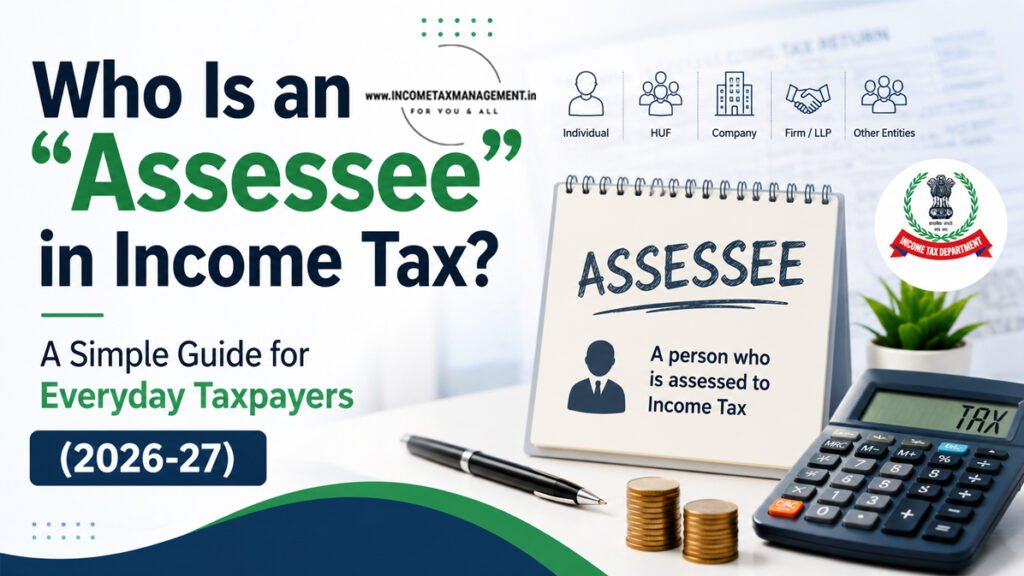
Learn Who Qualifies As An Assessee In Income Tax Under Section 2(7) Of The Income Tax Act. Understand Ordinary, Representative & Deemed Assessees With Real Examples.
Have you ever filed your income tax return and wondered, “What exactly does ‘assessee’ mean?” You’re not alone. Millions of Indians file taxes every year without fully understanding this fundamental term.
Under India’s Income Tax Act, 1961, the word “assessee” is the cornerstone of every tax obligation, proceeding, and penalty. Whether you’re a salaried employee, a business owner, or even a legal guardian, knowing your status matters. It determines your filing duties, your liability, and even who faces the music if something goes wrong.
This guide breaks down everything you need to know about being an assessee in income tax—in plain English, with real examples, and fully updated for the Financial Year 2026-27 (Assessment Year 2027-28).
What Does “Assessee” Actually Mean? (Section 2(7) Explained)
The Legal Definition
Section 2(7) of the Income Tax Act, 1961 defines an assessee as:
“A person by whom any tax or any other sum of money (interest, penalty, etc.) is payable under this Act.”
In simpler words: An assessee is anyone who owes money to the Income Tax Department. That “money” isn’t just tax on your salary. It includes interest, penalties, fines, and even refunds you’re claiming.
But the definition goes further. You are also an assessee if:
- Any proceeding under the Income Tax Act has been initiated against you
- You are deemed to be an assessee under any specific provision
- You are deemed to be an assessee in default for failing a statutory duty
Why This Definition Matters
Think of the Income Tax Act as a rulebook. Before the taxman can knock on your door, the law must first recognize you as an “assessee.” This label triggers your rights, your responsibilities, and the department’s powers over you.
For example:
If you earn ₹6 lakh a year and your tax liability is zero after deductions, you may still need to file a return. Why? Because the Act requires certain persons to file even when no tax is due. That makes you an assessee.
The Four Main Types of Assessees
Not every assessee is the same. The law recognizes different categories based on your role and situation. Let’s look at each one.
1. Ordinary Assessee
This is the most common type. You are an ordinary assessee if any of these apply to you:
- Your income is being assessed by the tax department
- You are claiming a loss that needs official recognition
- You are seeking a refund of excess tax paid
For example:
Priya earns ₹10 lakh as a software engineer. She pays TDS of ₹1 lakh but her actual tax liability is only ₹75,000. When she files her return to claim the ₹25,000 refund, she is an ordinary assessee.
2. Representative Assessee (Sections 160–163)
Sometimes, the person who earns the income cannot handle tax matters themselves. The law then appoints a representative assessee to step into their shoes.
| Situation | Who Becomes Representative Assessee |
| Deceased person left income/wealth | Legal heir or executor of the estate |
| Minor child earns income | Parent or legal guardian |
| Person of unsound mind earns income | Guardian or committee appointed by court |
| Non-resident earns income in India | Agent or person receiving income on their behalf |
| Trust or estate generates income | Trustee or official managing the trust |
For example:
Mr. Sharma, a UK-based NRI, owns a flat in Mumbai that he rents out for ₹40,000 per month. Since he lives abroad, his cousin Raj manages the property and collects rent. Under Section 163, Raj becomes the representative assessee. Raj must file returns, pay tax, and respond to notices on Mr. Sharma’s behalf.
3. Assessee-in-Default
This is the category nobody wants to be in. You become an assessee-in-default when you fail to fulfill a statutory obligation—essentially, when you break a specific tax rule.
The two most common scenarios are:
| Default | Section | What Happens |
| Employer fails to deduct TDS from salary/payments | Section 201 | Employer becomes assessee-in-default; must pay tax + interest |
| Seller fails to collect TCS on specified goods | Section 206C | Seller becomes assessee-in-default; must pay tax + interest |
For example:
ABC Pvt. Ltd. pays ₹5 lakh as professional fees to a consultant but forgets to deduct 10% TDS. The company is now an assessee-in-default under Section 201. It must pay the ₹50,000 tax itself, plus interest at 1% per month, and may face penalties.
4. Deemed Assessee
The law treats certain persons as assessees “by default” due to specific circumstances, even if they didn’t earn the income themselves.
| Situation | Deemed Assessee Under | Why |
| Legal heir inherits income of deceased | Section 159 | Continues tax liability of the deceased |
| Successor takes over a business | Section 170 | Assumes tax obligations of the predecessor |
| Liquidator winds up a company | Section 178 | Must clear company’s tax dues before distributing assets |
For example:
After Mr. Gupta’s death, his son Arjun inherits a rental property generating ₹3 lakh annually. Even though Arjun didn’t earn this income originally, he becomes a deemed assessee under Section 159. He must file returns for his father’s income and pay any outstanding tax.
Key Distinctions Every Taxpayer Should Know
Person vs. Assessee: What’s the Difference?
Here’s a concept that trips up even seasoned taxpayers.
Under Section 2(31), a “person” includes:
- Individuals
- Hindu Undivided Families (HUFs)
- Companies
- Firms
- Associations of Persons (AOPs)
- Bodies of Individuals (BOIs)
- Local authorities
- Artificial juridical persons
The golden rule: All assessees are persons, but not all persons are assessees.
A person becomes an assessee only when:
- Their income exceeds the basic exemption limit, OR
- They are required to file a return mandatorily (like those with foreign assets), OR
- They have a statutory obligation like TDS/TCS
For example:
Ramesh is a college student with no income. He is a “person” under the Act but not an “assessee.” However, if he wins ₹15 lakh in a lottery, he instantly becomes an assessee because tax is deductible at source.
When Does Tax Liability Actually Begin?
You don’t need to wait for the tax department to tell you. Your liability starts when:
- Your total income exceeds the basic exemption limit for the financial year
- You are mandatorily required to file a return (e.g., if you have foreign income, hold foreign assets, or are a company/firm)
- You are responsible for deducting or collecting tax (TDS/TCS)
Updated for FY 2026-27: The basic exemption limits under the new tax regime are as follows:
| Taxpayer Category | Basic Exemption Limit (New Regime) | Basic Exemption Limit (Old Regime) |
| Individual (< 60 years) | ₹3,00,000 | ₹2,50,000 |
| Senior Citizen (60–80 years) | ₹3,00,000 | ₹3,00,000 |
| Super Senior Citizen (> 80 years) | ₹3,00,000 | ₹5,00,000 |
| Hindu Undivided Family (HUF) | ₹3,00,000 | ₹2,50,000 |
Note: These limits are subject to changes announced in the Union Budget 2026. Always verify with the latest Finance Act.
Special Cases: Who Is the Assessee Here?
Tax law gets tricky in real-life situations. Let’s decode some common scenarios.
| Situation | Who Is the Assessee? | Reason |
| Minor’s income is clubbed with parent’s income under Section 64 | Parent is the assessee | The parent reports and pays tax on the clubbed income |
| NRI earns rental income from Indian property | NRI is the assessee; may appoint an agent as representative assessee | Income is sourced in India, so it is taxable |
| HUF earns business income | Karta (head of the family) acts as the representative assessee | HUF is a separate taxable entity but represented by the Karta |
| Company goes into liquidation | Liquidator becomes the assessee | Must settle tax dues before paying creditors or shareholders |
| Trust distributes income to beneficiaries | Trustee is the representative assessee | Manages tax compliance for the trust |
For example:
The Kapoor HUF runs a family textile business earning ₹25 lakh annually. While the HUF itself is the taxable entity, the Karta (say, Mr. Kapoor, the eldest male member) files the return, maintains books, and represents the HUF in all tax proceedings. He is the representative assessee.
Practical Implications of Being an Assessee
Understanding your status isn’t just academic. It affects your day-to-day life in three big ways.
1. Return Filing Obligation
Only assessees are required to file income tax returns. If you are not an assessee, you generally don’t need to file—unless a specific provision mandates it.
However, many people choose to file even when not strictly required. Why? Because:
- It creates a financial record for loans and visas
- It helps claim refunds of TDS already deducted
- It is mandatory if you have foreign assets or signing authority in foreign accounts
2. Tax Proceedings and Assessments
All assessments, scrutiny notices, and appeals are conducted in the name of the assessee. This means:
- You (or your representative) must respond to notices
- You must produce books of accounts and supporting documents
- You have the right to appeal against adverse orders
For example:
If the tax department selects your return for scrutiny under Section 143(3), the notice will be addressed to you as the assessee. Ignoring it can lead to penalties and ex-parte assessments.
3. Legal Responsibility for Records
Every assessee must maintain proper books of account and documents. The requirements vary:
| Assessee Type | Record-Keeping Requirement |
| Individual/HUF (profession/business income) | Books as per Section 44AA if turnover/professional receipts exceed prescribed limits |
| Company | Mandatory audited books under Companies Act |
| Person liable for TDS/TCS | TDS/TCS statements, challans, and certificates |
Failure to maintain records can attract penalties under Section 271A.
Real-World Scenarios: Are You an Assessee?
Let’s test your understanding with practical examples.
Scenario 1: The Salaried Employee
Rohit earns ₹8.5 lakh per year as a marketing manager. His employer deducts TDS of ₹45,000. Rohit also has a PPF contribution of ₹1.5 lakh.
Is Rohit an assessee? Yes. He is an ordinary assessee. His income exceeds the exemption limit, and he must file a return to report his income, claim deductions, and reconcile his TDS.
Scenario 2: The NRI Landlord
Mrs. Patel lives in New Jersey but owns two apartments in Bangalore. She earns ₹6 lakh annually in rent. Her brother in Bangalore collects the rent and deposits it in her Indian account.
Is Mrs. Patel an assessee? Yes. Her Indian-sourced income is taxable in India. She is an ordinary assessee. Her brother could be appointed as a representative assessee if she authorizes him.
Scenario 3: The Forgetful Employer
XYZ Solutions, a small IT firm, pays ₹3 lakh to a freelance designer but fails to deduct 10% TDS as required under Section 194J.
Is XYZ Solutions an assessee? Yes, and more. It is an ordinary assessee for its own income. Additionally, it becomes an assessee-in-default under Section 201 for the TDS failure. It must now pay the ₹30,000 tax, plus interest at 1% per month from the date the TDS was due.
Scenario 4: The Deceased Taxpayer’s Heir
Mr. Reddy passed away in March 2026, leaving a pending tax assessment for FY 2024-25 and rental income continuing in FY 2025-26. His son, Vikram, inherits the properties.
Is Vikram an assessee? Yes. Under Section 159, Vikram becomes a deemed assessee. He must complete his father’s pending assessment and file returns for the post-death rental income.
Frequently Asked Questions (FAQ)
Q.1. Who is considered an assessee under the Income Tax Act?
An assessee is any person by whom tax, interest, penalty, or any other sum is payable under the Income Tax Act, 1961. This includes individuals, companies, HUFs, and others who either earn taxable income, are subject to tax proceedings, or fail to meet statutory obligations like TDS.
Q.2. What is the difference between a person and an assessee?
All assessees are persons, but not all persons are assessees. A “person” is a broad legal category under Section 2(31) that includes individuals, companies, firms, and more. A person becomes an “assessee” only when they have a tax liability, are party to a tax proceeding, or are deemed so by law.
Q.3. Can a minor be an assessee?
A minor can earn income (for example, through investments or talent fees), but their income is usually clubbed with that of the parent under Section 64. In such cases, the parent is the assessee, not the minor. However, if a minor earns income through manual work or specialized skill, they may be assessed independently.
Q.4. What happens if I am declared an assessee-in-default?
If you are an assessee-in-default (for example, for failing to deduct TDS), you must pay the tax amount that should have been deducted, plus interest at 1% per month from the due date. You may also face penalties under Section 271C and prosecution in severe cases.
Q.5. Is a legal representative always a representative assessee?
Not always. A legal representative becomes a representative assessee only when they step into the shoes of the original taxpayer—for instance, managing a deceased person’s tax affairs or handling an NRI’s Indian income. They do not automatically become assessees for their own unrelated income.
Conclusion: Know Your Status, Stay Compliant
The term “assessee” may sound like dry legal jargon, but it is the foundation of your entire relationship with the Income Tax Department. Whether you are an ordinary taxpayer filing your annual return, a guardian managing a minor’s assets, or a company director ensuring TDS compliance, your status determines your duties and your risks.
Here’s a quick recap:
- Ordinary assessee: Anyone with taxable income, a loss claim, or a refund due
- Representative assessee: Someone acting on behalf of another (minors, NRIs, deceased persons)
- Assessee-in-default: Someone who failed a statutory duty like TDS/TCS
- Deemed assessee: Someone the law treats as an assessee due to special circumstances
Understanding where you fit helps you file correctly, respond to notices confidently, and avoid costly penalties. When in doubt, consult a chartered accountant—because in tax matters, what you don’t know can hurt you.

![Residential Status [Sections 5 to 9B]](https://incometaxmanagement.in/wp-content/uploads/2023/09/Residential-Status-Sections-5-to-9B-1024x683.jpg)
![EXEMPTED INCOMES [Section – 10, 10AA, 11 to 13A]](https://incometaxmanagement.in/wp-content/uploads/2023/09/Exempted-Incomes-Section-10-1024x683.jpg)

![Income of an Electoral Trust shall be Exempt [Section 13B]](https://incometaxmanagement.in/wp-content/uploads/2023/10/61-Exempted-Incomes-Section-13B-1024x683.png)
![Incomes of Political Parties [Section-13A]](https://incometaxmanagement.in/wp-content/uploads/2023/10/60-Exempted-Incomes-Section-13A-1024x683.png)
![Special Provisions in respect of Newly-established Units in Special Economic Zones (SEZ) [Section-10AA]](https://incometaxmanagement.in/wp-content/uploads/2023/10/59-Exempted-Incomes-Section-10AA-1024x683.png)
![Exemption in respect of income chargeable to Equalization Levy [Section 10(50)]](https://incometaxmanagement.in/wp-content/uploads/2023/10/58-Exempted-Incomes-Section-1050-1024x683.png)
![Income of a Developmental Financing Institution (DFI) to be Exempt [Section 10(48E)]](https://incometaxmanagement.in/wp-content/uploads/2023/10/57-Exempted-Incomes-Section-1048E-1024x683.png)