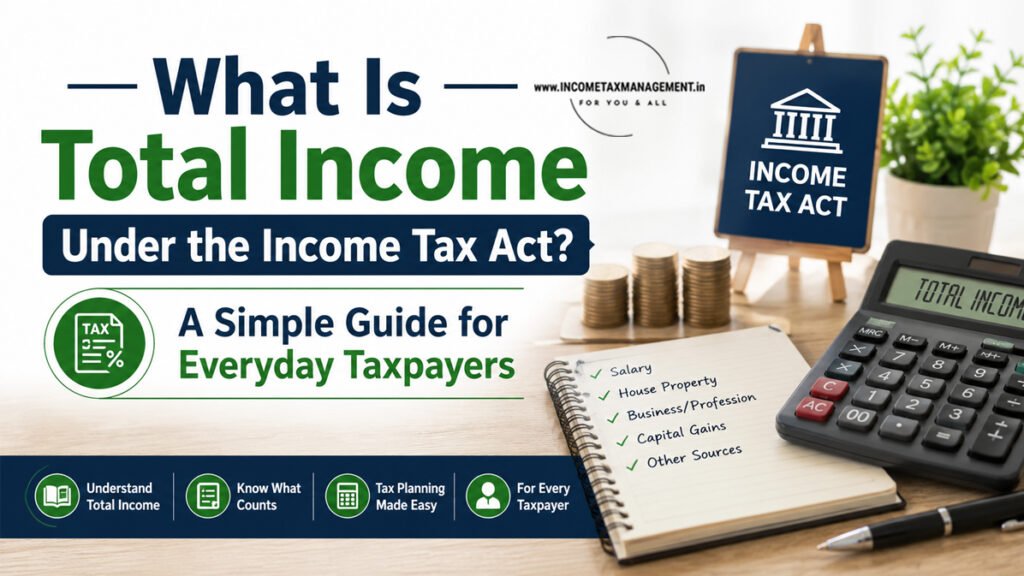
Learn How Total Income Under Income Tax Act Is Calculated For The 1961 Law. Discover The 5 Heads Of Income, Computation Steps, And Updated FY 2026–27 Tax Slabs With Real Examples.
Have you ever stared at your Form 16 or ITR form and wondered, “What exactly is my ‘Total Income,’ and why does it matter?” You’re not alone. Every year, millions of Indian taxpayers file their returns without fully grasping this fundamental term. And here’s the truth: understanding your Total Income is the first step to paying the right tax—and not a rupee more.
In this guide, we’ll break down what “Total Income” really means under the Income Tax Act, 1961 (as updated for FY 2026–27 / AY 2027–28). We’ll walk through the legal definition, the five heads of income, how to compute it step-by-step, and a real-world example you can relate to. By the end, you’ll know exactly how the taxman calculates what you owe.
The Legal Definition: What Does “Total Income” Actually Mean?
Section 2(45) of the Income Tax Act
The Income Tax Act defines “Total Income” in Section 2(45) as:
“The total amount of income referred to in Section 5, computed in the manner laid down in this Act.”
In plain English? Total Income is the final taxable amount left after you add up all your earnings, apply special adjustments (like clubbing income or setting off losses), and subtract all eligible deductions. It is the number on which the government actually calculates your tax.
Think of it like cooking a meal. You start with raw ingredients (your various incomes), mix them together, remove what you don’t need (deductions and exemptions), and the final dish is your Total Income.
How Is Total Income Computed? The Step-by-Step Formula
Before we dive into the five heads of income, let’s look at the simple formula the tax department uses:
Step 1: Add income from all 5 heads → Gross Total Income (GTI)
Step 2: Subtract Chapter VI-A deductions (Sections 80C to 80U) → Total Income
Here’s a cleaner view:
| Step | Description | Amount (₹) |
| A | Income from Salaries | XXX |
| B | Income from House Property | XXX |
| C | Profits from Business/Profession | XXX |
| D | Capital Gains | XXX |
| E | Income from Other Sources | XXX |
| Gross Total Income (GTI) | = A+B+C+D+E | |
| Less: Deductions under Chapter VI-A (80C to 80U) | (XXX) | |
| Total Income | = GTI – Deductions |
Key point: Gross Total Income is before deductions. Total Income is after deductions. The tax slabs are applied on your Total Income, not your GTI.
The Five Heads of Income (Section 14)
The Income Tax Act divides all income into five distinct heads. Every rupee you earn must fit into one of these buckets. Let’s explore each one.
1. Income from Salaries (Sections 15–17)
This head covers everything you earn as an employee. It includes:
- Basic salary and dearness allowance
- House Rent Allowance (HRA)
- Special allowances and perquisites
- Bonuses and commissions
- Employer contributions to your retirement fund
For example:
If you earn ₹15,00,000 per year as a software engineer, your entire salary package falls under this head.
2. Income from House Property (Sections 22–27)
If you own a house or building and earn rent from it, that income is taxed here. Even if the property is self-occupied, a notional income may be calculated (though a standard deduction of 30% on net annual value is allowed for let-out properties).
For example:
You own a flat in Bangalore and rent it out for ₹30,000 per month. Your annual rental income of ₹3,60,000 (minus municipal taxes and 30% standard deduction) is taxed under this head.
3. Profits and Gains from Business or Profession (Sections 28–44)
This head covers income from any trade, business, or profession after deducting allowable expenses. Freelancers, doctors, lawyers, shop owners, and startup founders all report income here.
For example:
A freelance graphic designer earning ₹8,00,000 annually, after deducting expenses like software subscriptions and internet bills, reports the net profit here.
4. Capital Gains (Sections 45–55)
When you sell a capital asset—like property, stocks, mutual funds, or gold—the profit you make is called capital gains. These are further classified as:
| Type | Holding Period | Tax Treatment (FY 2026–27) |
| Short-Term Capital Gains (STCG) | Listed securities: < 12 months;
Unlisted: < 24 months |
Equity: 15%;
Others: Slab rates |
| Long-Term Capital Gains (LTCG) | Listed securities: ≥ 12 months;
Unlisted: ≥ 24 months |
Equity: 12.5% (exempt up to ₹1.25 lakh);
Real estate: 12.5% with indexation for pre-July 2024 purchases |
For example:
You bought shares worth ₹2,00,000 and sold them for ₹3,50,000 after 18 months. Your LTCG of ₹1,50,000 is taxed at 12.5% (with the first ₹1,25,000 exempt).
5. Income from Other Sources (Sections 56–59)
This is the “catch-all” head for income that doesn’t fit anywhere else. Common examples include:
- Interest from savings accounts and fixed deposits
- Dividends from companies
- Lottery winnings and game show prizes
- Family pension
- Gifts received (under certain conditions)
For example:
You earned ₹50,000 in interest from your bank FDs. This amount is reported under “Other Sources.”
Special Adjustments Before You Reach Total Income
Before arriving at your Total Income, the law requires a few special adjustments. These ensure fairness and prevent tax avoidance.
Clubbing of Income (Sections 60–65)
If you transfer income to a family member (like your spouse or minor child) without actually transferring the asset, that income is “clubbed” back into your hands.
For example:
You invest ₹5,00,000 in your 10-year-old child’s name. The interest earned on that investment is added to your income, not your child’s.
Set-Off and Carry Forward of Losses (Sections 70–80)
Did you make a loss in one head of income? The Act lets you set off that loss against profits from another head. If you can’t set it off fully in the current year, you can carry it forward for future years.
For example:
You lost ₹1,00,000 in your small business but earned ₹3,00,000 from your salary. You can set off the loss against your salary income, reducing your taxable amount.
Exemptions (Section 10)
Certain incomes are fully exempt from tax and don’t even enter your Total Income. Popular ones include:
- Agricultural income (under specific conditions)
- House Rent Allowance (HRA) exemption
- Leave Travel Allowance (LTA) for domestic travel
- Gratuity and leave encashment (up to specified limits)
- Interest on PPF and Sukanya Samriddhi Yojana accounts
Chapter VI-A Deductions: Reducing Your Taxable Income
Once you have your Gross Total Income, you can claim deductions under Chapter VI-A (Sections 80C to 80U). These are the government’s way of rewarding savings, investments, and social spending.
Popular Deductions for FY 2026–27
| Section | What It Covers | Maximum Deduction (Old Regime) |
| 80C | PPF, ELSS, LIC premium, NSC, tuition fees, home loan principal | ₹1,50,000 |
| 80CCC | Pension plan annuity | Part of 80C limit |
| 80CCD(1) | NPS contribution by employee | Part of 80C limit |
| 80CCD(1B) | Additional NPS contribution | ₹50,000 (over and above 80C) |
| 80CCD(2) | Employer’s NPS contribution | 14% of salary (Govt) / 10% (Others) |
| 80D | Health insurance premium | ₹25,000 (₹50,000 for senior citizens) |
| 80DD | Maintenance of disabled dependent | ₹75,000 (₹1,25,000 for severe disability) |
| 80DDB | Medical treatment for specified diseases | ₹40,000 (₹1,00,000 for senior citizens) |
| 80E | Interest on education loan | Full amount |
| 80G | Donations to charitable institutions | 50% or 100% of donation |
| 80TTA | Interest on savings account (individuals) | ₹10,000 |
| 80TTB | Interest on deposits (senior citizens) | ₹50,000 |
Important note: Under the new tax regime (Section 115BAC), most Chapter VI-A deductions (including 80C, 80D, and HRA) are not available. However, the new regime offers lower tax rates and a standard deduction of ₹75,000 for salaried individuals.
Updated Income Tax Slabs for FY 2026–27 (AY 2027–28)
Here’s where the rubber meets the road. Your Total Income is taxed based on these slabs.
New Tax Regime (Default Option)
| Taxable Income (₹) | Tax Rate |
| Up to ₹4,00,000 | Nil |
| ₹4,00,001 – ₹8,00,000 | 5% |
| ₹8,00,001 – ₹12,00,000 | 10% |
| ₹12,00,001 – ₹16,00,000 | 15% |
| ₹16,00,001 – ₹20,00,000 | 20% |
| ₹20,00,001 – ₹24,00,000 | 25% |
| Above ₹24,00,000 | 30% |
Key benefits of the new regime:
- Income up to ₹12 lakh is effectively tax-free due to the Section 87A rebate of ₹60,000.
- For salaried individuals, the standard deduction of ₹75,000 pushes the tax-free limit to ₹12.75 lakh.
- No need to track investments or maintain receipts for deductions.
Old Tax Regime (If You Opt In)
| Taxable Income (₹) | Tax Rate (Below 60 Years) |
| Up to ₹2,50,000 | Nil |
| ₹2,50,001 – ₹5,00,000 | 5% |
| ₹5,00,001 – ₹10,00,000 | 20% |
| Above ₹10,00,000 | 30% |
Who should choose the old regime? If your total deductions and exemptions exceed approximately ₹4,33,333 (excluding standard deduction), the old regime might save you more tax.
Real-World Example: How to Calculate Total Income
Let’s bring this to life with a practical example. Meet Mr. Arjun Sharma, a 35-year-old marketing manager filing his return for FY 2026–27 (AY 2027–28).
Step 1: Calculate Gross Total Income
| Income Head | Amount (₹) |
| Salary (including allowances) | 16,00,000 |
| House Property (rental income, net) | 3,00,000 |
| Capital Gains (LTCG on equity) | 1,50,000 |
| Other Sources (bank interest) | 50,000 |
| Gross Total Income (GTI) | 21,00,000 |
Step 2: Claim Deductions (Old Regime)
| Deduction | Amount (₹) |
| Section 80C (PPF + ELSS + LIC) | 1,50,000 |
| Section 80D (health insurance for self + parents) | 50,000 |
| Section 80TTA (savings account interest) | 10,000 |
| Total Deductions | 2,10,000 |
Step 3: Arrive at Total Income
Gross Total Income: ₹21,00,000
Less: Total Deductions: ₹ 2,10,000
─────────────────────────────────────
Total Income: ₹18,90,000
Step 4: Calculate Tax Liability (Old Regime)
| Income Slab | Tax Rate | Tax Amount (₹) |
| Up to ₹2,50,000 | Nil | 0 |
| ₹2,50,001 – ₹5,00,000 | 5% | 12,500 |
| ₹5,00,001 – ₹10,00,000 | 20% | 1,00,000 |
| Above ₹10,00,000 | 30% | 2,67,000 |
| Total Tax | 3,79,500 | |
| Add: Health & Education Cess @ 4% | 15,180 | |
| Final Tax Payable | ₹3,94,680 |
Now, if Arjun chose the new regime:
- His Total Income would be ₹21,00,000 – ₹75,000 (standard deduction) = ₹20,25,000
- Tax under new regime = ₹2,63,750 + cess = ₹2,74,300
- Savings by choosing new regime: ~₹1,20,380
This is why understanding your Total Income—and comparing both regimes—is crucial!
Frequently Asked Questions (FAQ)
Q.1. What is the difference between Gross Total Income and Total Income?
Gross Total Income (GTI) is the sum of income from all five heads before any deductions. Total Income is what remains after subtracting eligible deductions under Chapter VI-A (Sections 80C to 80U). The tax slabs are applied on your Total Income.
Q.2. Is agricultural income included in Total Income?
Agricultural income is fully exempt under Section 10(1) and is not included in your Total Income. However, it may be considered for rate purposes if your non-agricultural income exceeds the basic exemption limit.
Q.3. Can I claim both 80C and 80D deductions?
Yes! Section 80C (investments up to ₹1,50,000) and Section 80D (health insurance premiums up to ₹25,000/₹50,000) are independent deductions. You can claim both, but only under the old tax regime. The new regime does not allow these deductions.
Q.4. What happens if my Total Income is below ₹5 lakh?
If your Total Income is up to ₹5 lakh under the old regime, you get a full rebate under Section 87A, meaning zero tax liability. Under the new regime, this rebate extends up to ₹12 lakh (₹12.75 lakh for salaried individuals after standard deduction).
Q.5. Do I need to include my minor child’s income in my Total Income?
Yes, under Section 64(1A), income earned by a minor child (below 18 years) from investments made by you is clubbed with your income. However, an exemption of ₹1,500 per child is allowed.
Final Thoughts: Master Your Total Income, Master Your Taxes
Understanding Total Income under the Income Tax Act isn’t just about filing returns correctly. It’s about taking control of your financial life. When you know how each rupee is classified, what deductions you can claim, and which tax regime suits you best, you make smarter money decisions.
Here’s a quick recap:
- Total Income = Gross Total Income – Chapter VI-A Deductions
- Income is classified under five heads: Salaries, House Property, Business/Profession, Capital Gains, and Other Sources
- Special adjustments like clubbing and loss set-off apply before final computation
- Choose between the old and new tax regimes wisely—run the numbers for both
- Stay updated with FY 2026–27 rules, including the new 7-slab structure and enhanced rebates
Pro tip: Use the Income Tax Department’s official e-filing portal or a reliable tax calculator to compare both regimes before filing your ITR. A few minutes of planning can save you thousands of rupees.

![Residential Status [Sections 5 to 9B]](https://incometaxmanagement.in/wp-content/uploads/2023/09/Residential-Status-Sections-5-to-9B-1024x683.jpg)

![EXEMPTED INCOMES [Section – 10, 10AA, 11 to 13A]](https://incometaxmanagement.in/wp-content/uploads/2023/09/Exempted-Incomes-Section-10-1024x683.jpg)

![Income of an Electoral Trust shall be Exempt [Section 13B]](https://incometaxmanagement.in/wp-content/uploads/2023/10/61-Exempted-Incomes-Section-13B-1024x683.png)
![Incomes of Political Parties [Section-13A]](https://incometaxmanagement.in/wp-content/uploads/2023/10/60-Exempted-Incomes-Section-13A-1024x683.png)
![Special Provisions in respect of Newly-established Units in Special Economic Zones (SEZ) [Section-10AA]](https://incometaxmanagement.in/wp-content/uploads/2023/10/59-Exempted-Incomes-Section-10AA-1024x683.png)
![Exemption in respect of income chargeable to Equalization Levy [Section 10(50)]](https://incometaxmanagement.in/wp-content/uploads/2023/10/58-Exempted-Incomes-Section-1050-1024x683.png)
![Income of a Developmental Financing Institution (DFI) to be Exempt [Section 10(48E)]](https://incometaxmanagement.in/wp-content/uploads/2023/10/57-Exempted-Incomes-Section-1048E-1024x683.png)