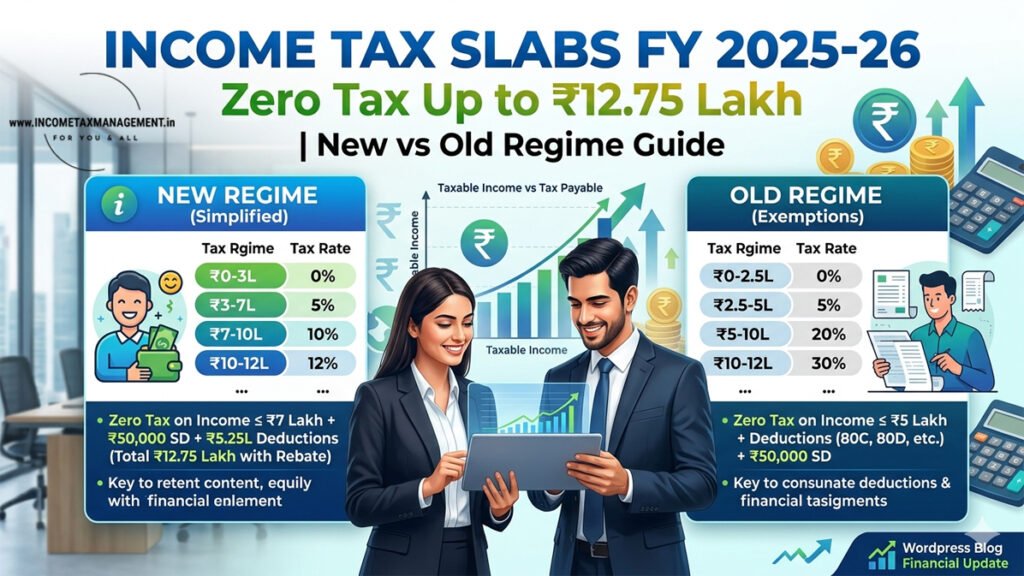
Discover The Latest Income Tax Slabs FY 2025-26 (AY 2026-27). Learn How to Pay Zero Tax Up To ₹12.75 Lakh, Compare New Vs Old Regimes, And Choose the Best Option.
What Changed in Your Tax Bill This Year?
Did you know that starting April 1, 2025, you might not have to pay a single rupee in income tax even if you earn ₹12.75 lakh per year? That’s right—the government made one of the biggest tax relief announcements in recent years through Budget 2025. But here’s the catch: these benefits only apply if you understand the new rules and pick the right tax regime.
If you’re feeling confused about whether to stick with the old tax regime or switch to the new one, you’re not alone. Millions of Indian taxpayers face this exact dilemma every financial year. The good news? This guide breaks down everything you need to know about income tax slabs for FY 2025-26 (AY 2026-27) in plain, simple English. No jargon, no confusion—just clear answers that help you keep more money in your pocket.
Understanding the New Tax Regime: Your Default Option
Since FY 2023-24, the new tax regime under Section 115BAC has been the government’s preferred system. For FY 2025-26, it became even more attractive. Think of it as a “simplified path” where you pay lower tax rates but give up most deductions and exemptions.
New Tax Regime Slabs for FY 2025-26
Here’s exactly how your income gets taxed under the new regime:
| Income Range (₹) | Tax Rate | Tax on This Slab |
| Up to ₹4,00,000 | 0% | ₹0 |
| ₹4,00,001 – ₹8,00,000 | 5% | ₹20,000 |
| ₹8,00,001 – ₹12,00,000 | 10% | ₹40,000 |
| ₹12,00,001 – ₹16,00,000 | 15% | ₹60,000 |
| ₹16,00,001 – ₹20,00,000 | 20% | ₹80,000 |
| ₹20,00,001 – ₹24,00,000 | 25% | ₹1,00,000 |
| Above ₹24,00,000 | 30% | ₹1,00,000 + 30% of excess |
Note: A 4% Health and Education Cess applies on the total tax payable. Surcharge applies for incomes above ₹50 lakh.
The Biggest Win: Zero Tax Up to ₹12.75 Lakh
This is where things get exciting. The government increased the Section 87A rebate from ₹25,000 to ₹60,000 for FY 2025-26. Here’s what that means for you:
- If your taxable income is ₹12 lakh or less, your entire tax liability gets wiped out by the rebate.
- For salaried employees, add the standard deduction of ₹75,000, and your effective tax-free income becomes ₹12.75 lakh.
For Example:
Meet Priya, a marketing manager earning ₹12.75 lakh annually. Under the new regime:
- She claims the standard deduction of ₹75,000
- Her taxable income drops to ₹12,00,000
- Tax calculated on ₹12 lakh = ₹60,000
- Section 87A rebate of ₹60,000 cancels this out completely
- Final tax payable: ₹0
That’s real money staying in her bank account instead of going to the government.
What Deductions Can You Still Claim?
The new regime is strict about deductions, but you do get a few:
- Standard Deduction: ₹75,000 (for salaried employees and pensioners)
- Employer’s NPS Contribution: Up to 14% of basic salary (Section 80CCD(2))
- Marginal Relief: If your income slightly exceeds ₹12 lakh, you won’t pay more tax than the amount exceeding the limit
However, popular deductions like Section 80C (PPF, ELSS, LIC), HRA exemption, home loan interest, and Section 80D (health insurance) are not allowed in the new regime.
The Old Tax Regime: Still Relevant for Some
The old tax regime remains unchanged for FY 2025-26. It offers fewer slab benefits but allows you to claim numerous deductions and exemptions. Think of it as the “customizable path” where you can reduce your taxable income significantly if you have the right investments and expenses.
Old Tax Regime Slabs for FY 2025-26
For Individuals Below 60 Years:
| Income Range (₹) | Tax Rate |
| Up to ₹2,50,000 | 0% |
| ₹2,50,001 – ₹5,00,000 | 5% |
| ₹5,00,001 – ₹10,00,000 | 20% |
| Above ₹10,00,000 | 30% |
For Senior Citizens (60–80 Years):
| Income Range (₹) | Tax Rate |
| Up to ₹3,00,000 | 0% |
| ₹3,00,001 – ₹5,00,000 | 5% |
| ₹5,00,001 – ₹10,00,000 | 20% |
| Above ₹10,00,000 | 30% |
For Super Senior Citizens (80+ Years):
| Income Range (₹) | Tax Rate |
| Up to ₹5,00,000 | 0% |
| ₹5,00,001 – ₹10,00,000 | 20% |
| Above ₹10,00,000 | 30% |
Key Features of the Old Regime
- Section 87A Rebate: ₹12,500 for incomes up to ₹5 lakh (much lower than the new regime)
- Standard Deduction: ₹50,000 for salaried employees
- Full Deduction Power: You can claim Section 80C (₹1.5 lakh), Section 80D (health insurance), HRA, home loan interest, and many more
New vs Old Regime: Side-by-Side Comparison
Choosing between these two systems can feel overwhelming. Here’s a clear comparison to help you decide:
| Feature | Old Tax Regime | New Tax Regime |
| Default Option | No | Yes |
| Basic Exemption | ₹2.5 lakh | ₹4 lakh |
| Standard Deduction | ₹50,000 | ₹75,000 |
| Section 87A Rebate | ₹12,500 (up to ₹5 lakh) | ₹60,000 (up to ₹12 lakh) |
| Section 80C Deductions | Allowed | Not Allowed |
| HRA Exemption | Allowed | Not Allowed |
| Home Loan Interest | Allowed | Not Allowed |
| Section 80D (Health Insurance) | Allowed | Not Allowed |
| NPS Deduction | Full | Only employer’s contribution |
| Surcharge Above ₹5 Crore | 37% | 25% |
| Best For | Heavy investors/deduction claimers | Salaried employees, moderate earners |
When Should You Choose the New Regime?
Pick the new regime if:
- Your income is under ₹12 lakh and you want zero tax hassle
- You don’t have significant investments in 80C, 80D, or home loans
- You’re a salaried employee with limited deductions to claim
- You prefer simplicity over paperwork
When Should You Stick with the Old Regime?
Stay with the old regime if:
- You claim deductions exceeding ₹2-3 lakh annually
- You pay hefty home loan EMIs or high rent (HRA)
- You invest heavily in PPF, ELSS, NPS, or insurance
- Your income is above ₹15 lakh and deductions significantly reduce taxable income
For Example: Rahul earns ₹15 lakh and claims the following deductions under the old regime:
- Section 80C (PPF + ELSS): ₹1,50,000
- Section 80D (Health insurance): ₹25,000
- HRA exemption: ₹1,20,000
- Home loan interest: ₹1,50,000
- Standard deduction: ₹50,000
Total deductions: ₹4,95,000 Taxable income: ₹10,05,000 Tax under old regime: Approximately ₹1,17,000
Under the new regime, his taxable income would be ₹14,25,000 (after ₹75,000 standard deduction), and his tax would be approximately ₹1,09,200. In this case, the old regime still wins, but only marginally. The gap is narrowing fast.
Other Important Changes in FY 2025-26
Beyond the slabs and rebates, Budget 2025 introduced several other taxpayer-friendly changes:
1. Higher TDS Thresholds
- Senior Citizens’ Interest Income: TDS threshold raised from ₹50,000 to ₹1 lakh per year. This means senior citizens can earn more interest before banks deduct tax at source.
- Rent TDS: Threshold increased to ₹50,000 per month (from ₹2.4 lakh per year). This helps landlords receiving higher rents.
2. TCS Relaxations
- Education Loans Under LRS: No TCS (Tax Collected at Source) on education loans for overseas remittances.
- Overseas Remittance Threshold: TCS threshold raised from ₹7 lakh to ₹10 lakh for other remittances under the Liberalized Remittance Scheme.
3. Surcharge Cap for High Earners
If your income exceeds ₹2 crore, the surcharge under the new regime is capped at 25% (compared to 37% in the old regime). This is a significant saving for ultra-high-net-worth individuals.
Step-by-Step: How to Calculate Your Tax for FY 2025-26
Follow these simple steps to figure out your tax liability:
- Calculate Gross Total Income: Add your salary, business income, capital gains, house property income, and other sources.
- Choose Your Regime: Decide between new and old based on your deductions.
- Apply Deductions: Subtract eligible deductions (standard deduction, 80C, 80D, etc.) based on your chosen regime.
- Find Taxable Income: This is your final income subject to tax.
- Apply Slab Rates: Use the appropriate tax slabs to calculate base tax.
- Claim Rebate: Apply Section 87A rebate if your income qualifies.
- Add Cess and Surcharge: Add 4% Health and Education Cess (and surcharge if applicable).
- Subtract Prepaid Taxes: Deduct TDS, TCS, or advance tax already paid to find your final balance or refund.
Frequently Asked Questions (FAQ)
Q1: Is income up to ₹12 lakh completely tax-free in FY 2025-26?
Yes, under the new tax regime, if your taxable income is up to ₹12 lakh, the Section 87A rebate of ₹60,000 will reduce your tax liability to zero. For salaried employees, with the ₹75,000 standard deduction, you can earn up to ₹12.75 lakh and still pay zero tax.
Q2: Can I switch between old and new tax regimes every year?
Salaried employees can choose their preferred regime every year when filing their ITR. However, individuals with business or professional income can switch only once in their lifetime—after switching to the new regime, they cannot go back to the old one.
Q3: What happens if my income is slightly above ₹12 lakh?
Marginal relief ensures you won’t pay more tax than the amount exceeding ₹12 lakh. For example, if you earn ₹12,10,000, your tax liability is capped at approximately ₹10,000 (the excess amount), not the full slab calculation.
Q4: Are senior citizens better off in the new regime?
Most senior citizens benefit from the new regime because the TDS threshold on interest income doubled to ₹1 lakh, and the rebate limit is much higher. However, those with significant deductions (like 80D for senior citizen health insurance) should compare both regimes carefully.
Q5: Do I need to submit investment proofs in the new tax regime?
No, that’s one of the biggest advantages. The new tax regime requires minimal documentation since most deductions are disallowed. You only need to claim the standard deduction and employer’s NPS contribution, if applicable.
Final Thoughts: Make an Informed Choice
The income tax slabs for FY 2025-26 (AY 2026-27) represent a clear push by the government toward the new tax regime. With zero tax up to ₹12.75 lakh for salaried employees, lower surcharge rates for high earners, and simplified compliance, the new regime is now genuinely attractive for a majority of taxpayers.
However, the old regime still holds value for those with substantial deductions. The best approach? Calculate your tax liability under both regimes before filing your ITR. Many online tax calculators can help you compare instantly.
Remember, tax planning isn’t about avoiding taxes—it’s about understanding the rules and making them work for you. With the right knowledge, you can significantly reduce your tax burden while staying fully compliant with the law.