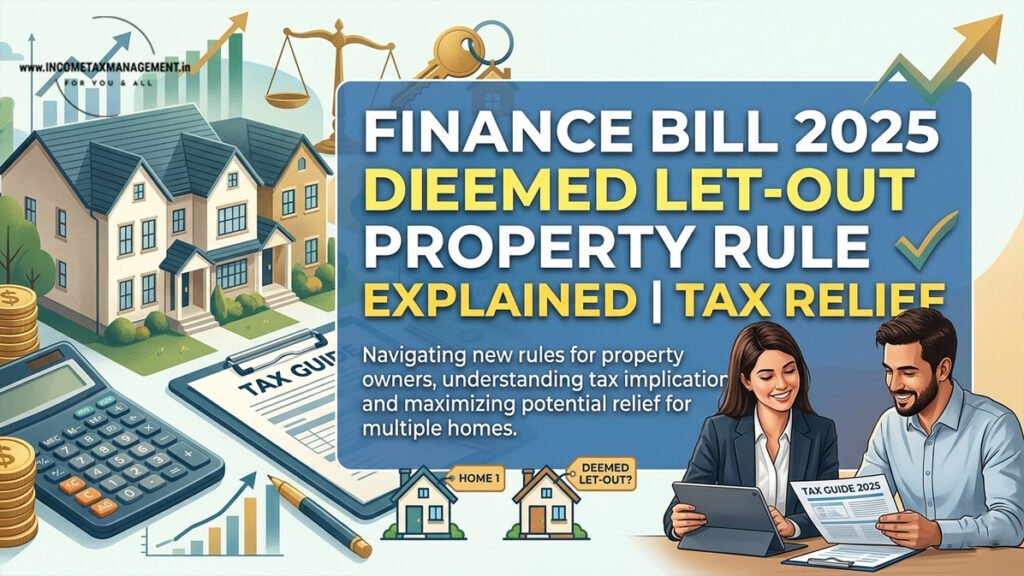
Finance Bill 2025 Relaxes Deemed Let-Out Property Rule. Now Own 2 Self-Occupied Homes Tax-Free Without Proving Employment Reasons. Learn How It Saves You Money.
Introduction: Tired of Paying “Ghost Rent” on Your Own Home?
Do you own a second house that sits empty most of the year? Maybe it’s a vacation home in the hills, a flat near your parents’ city, or simply a property you haven’t moved into yet.
Here’s the frustrating part: until now, the taxman treated that empty house as if you were earning rent from it—even if you weren’t. This “deemed let-out” rule forced many homeowners to pay tax on imaginary income. You had to prove you couldn’t live there because of your job or business. No proof? Pay up.
But here’s the good news.
The Finance Bill 2025 (effective from April 1, 2025) changes everything. The government has removed those strict conditions. Now, you can declare any two properties as self-occupied—regardless of why you don’t live in the second one. No more proving employment reasons. No more calculating notional rent. No more “ghost tax.”
In this guide, I’ll walk you through exactly what changed, how much you could save, and what you need to do when filing your Income Tax Return (ITR) for the Assessment Year 2026-27.
What Exactly Changed? The Old Rule vs. The New Rule
Let’s cut through the jargon and look at the real difference.
The Old Rule (Before April 1, 2025)
Under Section 23(2) of the Income Tax Act, 1961, you could claim two properties as self-occupied (with zero taxable value) only if:
- The first property was where you actually lived.
- The second property was unoccupied only because of your employment, business, or profession located elsewhere.
In other words, if you owned a flat in Goa but worked in Delhi, you were fine. But if you simply kept a second home for weekend getaways or family use? The tax department assumed you were earning rent from it. You had to pay tax on a “deemed” (imaginary) annual value.
This meant:
- Heavy documentation burden.
- Confusion over what counted as a valid reason.
- Unnecessary tax on properties generating zero actual income.
The New Rule (From April 1, 2025 Onwards)
The Finance Bill 2025 amends Section 23(2) to remove the occupation condition entirely. Here’s what you can now do:
- Declare any two residential properties as self-occupied.
- No need to justify why the second property is vacant.
- The reason can be anything—vacation use, future retirement home, family property, or personal preference.
Important: The third property onwards still gets the deemed let-out treatment. Notional rent will apply.
Quick Comparison Table
| Scenario | Pre-2025 Treatment | Post-2025 Treatment |
| Two self-occupied properties | Only one fully tax-free; second tax-free only if unoccupied due to employment/business | Both fully tax-free (nil annual value), no reason required |
| Three or more properties | Two tax-free (if conditions met); third onwards deemed let-out | Two tax-free (no conditions); third onwards deemed let-out |
| Second home used as vacation home | Deemed let-out; tax on notional rent | Self-occupied; zero tax |
| Second home kept for parents | Deemed let-out; tax on notional rent | Self-occupied; zero tax |
Real-World Example: How Much Can You Actually Save?
Numbers speak louder than rules. Let’s look at a practical scenario.
Meet Mr. Sharma
Mr. Sharma owns three residential properties:
- Delhi: Where he lives with his family (self-occupied).
- Mumbai: A flat he bought for weekend stays and occasional work trips.
- Goa: A beach house he visits twice a year.
Before Finance Bill 2025:
- Delhi: Self-occupied, zero tax. ✅
- Mumbai: He had to prove his Mumbai visits were strictly for business. Since he used it for leisure too, the tax department could deem it let-out. Tax applied on notional rent of ₹40,000 per month (₹4.8 lakh annually). At a 30% tax bracket, that’s roughly ₹1.44 lakh extra tax per year.
- Goa: Automatically deemed let-out. Another notional rent hit.
After Finance Bill 2025:
- Delhi: Self-occupied, zero tax. ✅
- Mumbai: He simply declares it as his second self-occupied property. Zero tax. No questions asked.
- Goa: Deemed let-out (as it’s the third property). Notional rent applies here.
Net savings: Approximately ₹1.44 lakh per year just on the Mumbai property alone.
Another Example: The Retired Couple
Mr. and Mrs. Gupta live in Jaipur. They own:
- Their main home in Jaipur.
- A small flat in Pune near their daughter’s family, which they visit for 3–4 months a year.
Before 2025: The Pune flat would likely be deemed let-out because their visits weren’t employment-related. They’d pay tax on imaginary rent.
After 2025: They declare the Pune flat as their second self-occupied property. Full tax relief. They save money, paperwork, and stress.
Why Did the Government Make This Change?
You might wonder: why is the government suddenly being generous? There are three solid reasons behind this relaxation.
1. Reduced Compliance Burden
The old rule created a paperwork nightmare. Taxpayers had to maintain employment letters, transfer orders, or business proof just to justify owning two homes. The new rule removes this entirely. You tick a box. Done.
2. Boost to Real Estate Investment
Secondary homes and vacation properties often sat in a tax gray area. By removing the notional rent penalty, the government makes owning a second home genuinely attractive. This is especially relevant for:
- Tier 2 and Tier 3 cities where property prices are lower.
- Retirement planning (buying a future home early).
- Family convenience (keeping a home near relatives).
3. Simplified Tax Filing
Calculating notional rent isn’t straightforward. You had to determine the expected rental value based on municipal rates, comparable properties, and location factors. Now, for your first two properties, you skip all of this. Less math, fewer errors, faster ITR filing.
What Stays the Same? Don’t Ignore These Rules
While the relaxation is significant, some things haven’t changed. Here’s what you still need to watch.
The Third Property Rule
Own three houses? The third one is still deemed let-out. You must calculate its gross annual value based on:
- Municipal valuation, or
- Fair rent (what similar properties in the area fetch), or
- Standard rent (if covered under Rent Control Act).
Whichever is highest determines your taxable income. You can still deduct municipal taxes paid and claim a standard deduction of 30% on the net annual value.
Home Loan Interest Deduction
If you have a home loan on your self-occupied property:
- Self-occupied property: Deduction up to ₹2 lakh per year under Section 24(b).
- Deemed let-out property: Full interest deduction allowed (no ₹2 lakh cap). This is actually better for the third property.
So while your third property faces notional rent tax, you get unlimited interest deduction against it. This can sometimes offset the tax liability.
Principal Repayment Under Section 80C
This remains unchanged. Principal repayment up to ₹1.5 lakh per year qualifies for deduction under Section 80C, regardless of whether the property is self-occupied or deemed let-out.
Step-by-Step: How to Declare Two Self-Occupied Properties in Your ITR
Filing for Assessment Year 2026-27? Here’s exactly what to do.
Step 1: Identify Your Properties
List all residential properties you own. Pick the two you want to declare as self-occupied. Usually, these should be the ones with the highest notional rent values to maximize tax savings.
Step 2: Calculate Notional Rent for the Third Property
For any property beyond the first two:
- Find the municipal valuation.
- Determine fair rent based on similar properties.
- Apply standard rent if under Rent Control.
- Take the highest of these three as your gross annual value.
- Deduct municipal taxes paid to get net annual value.
- Deduct 30% standard deduction from net annual value.
- Deduct actual home loan interest (unlimited).
Step 3: Fill Schedule HP in ITR-2 or ITR-3
- Self-occupied properties: Enter “0” as annual value. Claim interest deduction up to ₹2 lakh per property (total cap may apply; consult a tax advisor).
- Deemed let-out property: Enter the computed annual value and deductions as calculated above.
Step 4: Keep Documentation Ready
Even though the occupation condition is removed, maintain:
- Ownership documents for all properties.
- Municipal tax receipts.
- Home loan interest certificates.
- Rent agreements if any property is actually let out.
Who Benefits the Most from This Change?
Not everyone gains equally. Here are the biggest winners.
Homeowners with Vacation or Weekend Homes
If you bought a hill station flat or a beach house for personal use, you no longer pay tax on imaginary rent. Your holiday just got cheaper.
Professionals with Properties in Multiple Cities
Doctors, consultants, and business owners who own homes in different cities for convenience—not because of a specific job posting—can now claim both as self-occupied.
Families with Inter-Generational Properties
Many families keep a ancestral home in their native town while living in a city for work. Previously, the ancestral home often fell into the deemed let-out trap. Now, it’s protected.
Real Estate Investors in Tier 2/3 Cities
With lower entry prices and now zero notional rent tax on a second property, investing in smaller cities becomes more viable. You can hold a property for appreciation without annual tax leakage.
Potential Pitfalls to Avoid
Before you celebrate, watch out for these common mistakes.
Mistake 1: Assuming All Properties Are Tax-Free
Only two properties get the self-occupied benefit. The third onwards still attract deemed let-out tax. Don’t skip calculating notional rent for additional properties.
Mistake 2: Ignoring State-Level Taxes
Income tax relaxation is central. However, property tax, stamp duty, and registration charges vary by state. Budget for these separately.
Mistake 3: Forgetting to Update ITR Forms
Ensure you’re using the latest ITR forms for AY 2026-27. Older forms may not reflect the amended Section 23(2) correctly.
Mistake 4: Misclassifying Commercial Property
This relaxation applies only to residential properties. A shop, office, or commercial building cannot be declared self-occupied under this rule.
Frequently Asked Questions (FAQ)
Q.1. Can I declare any two properties as self-occupied, even if both are in the same city?
Yes. The Finance Bill 2025 removes the location restriction. Whether your two properties are in the same city or different cities, you can declare both as self-occupied. The only condition is that they must be residential properties.
Q.2. What happens if I own three properties but one is actually rented out?
You have flexibility. If one property is genuinely rented out, you can treat the other two as self-occupied (nil value). The rented property gets taxed on actual rent received, not notional rent. This often works out better than deeming the third property as let-out.
Q.3. Does this change affect my capital gains tax when I sell a property?
No. This relaxation applies only to annual income tax under “Income from House Property.” Capital gains tax under Section 54, 54F, and related provisions remain unchanged. You still get indexation benefits and exemption on reinvestment.
Q.4. Can I claim home loan interest on both self-occupied properties?
Yes, but with a catch. You can claim interest deduction on both, but the total deduction for self-occupied properties is capped at ₹2 lakh per year under Section 24(b). If your combined interest exceeds this, the excess cannot be claimed against other income heads. However, for a deemed let-out third property, interest deduction is unlimited.
Q.5. Is this benefit available for the Assessment Year 2025-26?
No. The Finance Bill 2025 is effective from April 1, 2025. This means it applies to the Financial Year 2025-26 and the corresponding Assessment Year 2026-27. For AY 2025-26 (FY 2024-25), the old rules still apply.
Bottom Line: A Simpler, Fairer Tax Rule
The Finance Bill 2025’s relaxation of deemed let-out property rules is one of the most taxpayer-friendly changes in recent years. It acknowledges a simple reality: owning two homes doesn’t automatically mean you’re a landlord.
By removing the employment-linked occupation condition, the government has:
- Saved you from paying tax on income you never earned.
- Cut down compliance paperwork significantly.
- Made real estate investment in secondary homes genuinely attractive.
If you own two residential properties, review your tax strategy for AY 2026-27. Declare both as self-occupied. Calculate notional rent only for the third property onwards. And most importantly, keep your documentation clean.
Tax rules change. Smart taxpayers adapt. This is one change that works entirely in your favor.