Finance Bill 2025 Extends ITR-U Filing To 4 Years With 25%-70% Additional Tax. Learn Deadlines, Eligibility, Costs & How To File Updated Returns In India.
Did you forget to report some income on last year’s tax return? Maybe you missed a deduction, chose the wrong ITR form, or simply forgot to file altogether. If that sounds familiar, don’t panic — you’re not alone, and the government has actually given you a much longer safety net than before.
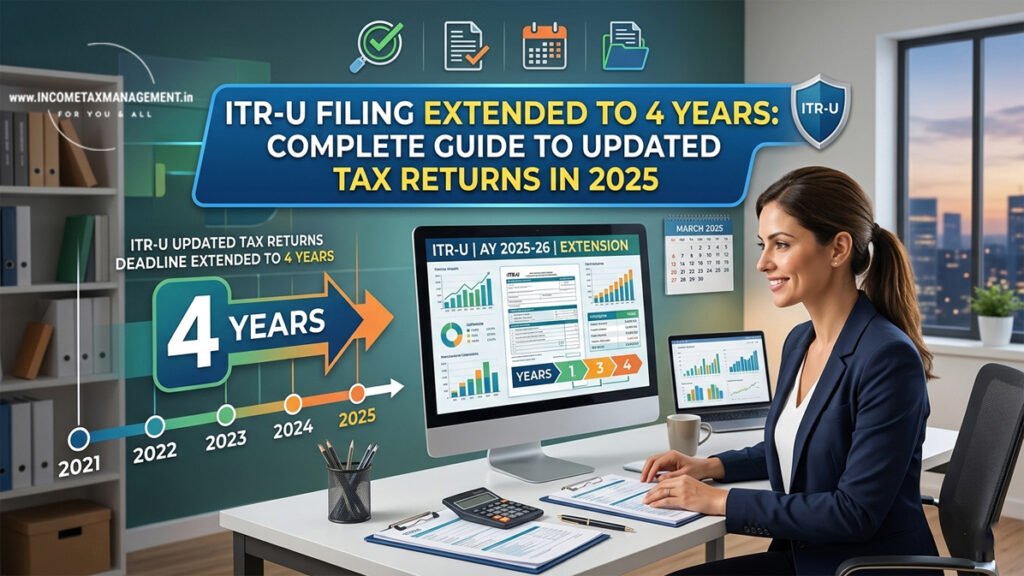
Thanks to the Finance Bill 2025, the time limit for filing an Updated Income Tax Return (ITR-U) has been doubled from 2 years to 4 years from the end of the relevant Assessment Year. That means for the financial year 2024-25 (AY 2025-26), you now have until 31 March 2030 to correct your mistakes — but the longer you wait, the more additional tax you’ll pay.
In this guide, we’ll break down everything you need to know about ITR-U filing in plain English: who can use it, what it costs, what you cannot do with it, and how to file it step-by-step.
What Is an Updated Tax Return (ITR-U)?
An Updated Income Tax Return, or ITR-U, is a special provision under Section 139(8A) of the Income Tax Act, 1961. Think of it as a “second chance” form. It allows taxpayers to:
- File a return they completely missed
- Correct errors or omissions in an already filed return
- Report income they forgot to disclose earlier
- Fix mistakes like choosing the wrong income head or wrong tax rate
The best part? You can file ITR-U even if you never filed the original return, missed the belated return deadline, or already filed a revised return. It’s designed to encourage voluntary compliance and reduce tax disputes.
However, there’s a catch: you can only file one updated return per assessment year, and you cannot use it to claim refunds or reduce your tax liability.
The Big Change: 4-Year Window Under Finance Bill 2025
Before April 2025, you only had 24 months (2 years) from the end of the assessment year to file an updated return. The Finance Bill 2025 changed that dramatically.
Here’s what changed:
| Feature | Before April 2025 | After April 2025 (Current) |
| Time Limit | 24 months from end of AY | 48 months from end of AY |
| Maximum Additional Tax | 50% | 70% |
| New Tax Slabs | 25% (Year 1), 50% (Year 2) | 25%, 50%, 60%, 70% |
This means taxpayers now get double the time to come clean, but the government has also introduced two new penalty tiers (60% and 70%) for those who wait beyond the second year.
ITR-U Deadlines and Additional Tax Rates (Updated for FY 2025-26)
The additional tax you pay depends entirely on when you file. The sooner you act, the less you pay. Here’s the complete breakdown:
| When You File ITR-U | Extended Deadline (AY 2025-26) | Additional Tax Payable | What It Means |
| Within 12 months from end of AY | 31 March 2027 | 25% of (tax + interest) | Best option — lowest cost |
| Within 24 months from end of AY | 31 March 2028 | 50% of (tax + interest) | Double the cost of Year 1 |
| Within 36 months from end of AY | 31 March 2029 | 60% of (tax + interest) | New tier — 10% jump |
| Within 48 months from end of AY | 31 March 2030 | 70% of (tax + interest) | Maximum cost — last chance |
Key Point: This additional tax is calculated on the aggregate of additional tax and interest payable on the updated return. It does not include late filing fees under Section 234F.
Who Can File ITR-U Under Section 139(8A)?
You are eligible to file an updated return if you need to correct any of the following:
- Missed filing the original, belated, or revised return
- Under-reported income or forgot to disclose certain earnings
- Wrong income head selected (for example, reported business income as “Other Sources”)
- Wrong tax rate applied
- Reduce carried-forward losses or unabsorbed depreciation
- Reduce tax credit under Sections 115JB or 115JC
For Example:
Rahul, a freelance graphic designer, filed his ITR for AY 2025-26 but forgot to report ₹3 lakh he earned from a side project. He can file ITR-U to disclose this income, pay the additional tax, and keep his records clean.
Who Cannot File ITR-U? Important Exclusions
Not everyone can use this facility. You cannot file ITR-U if:
- You want to file a nil return or a loss return
- The updated return would reduce your tax liability
- You want to claim a refund or increase an existing refund
- Your case is already under scrutiny, audit, or reassessment
- A survey has been conducted under Section 133A
- Search and seizure proceedings are ongoing
- Books or assets have been seized under Section 132A
For Example:
Priya realizes she overpaid tax and wants a refund. She cannot use ITR-U for this. She would need to explore other legal remedies, not the updated return route.
Budget 2026 Update: As per the latest proposals, updated returns may soon be allowed even after reassessment proceedings begin — but with an extra 10% tax on top of the existing rates. This is still under discussion.
How to Calculate Your Total Tax Liability for ITR-U
Before you file, you need to know exactly how much you owe. Here’s the simple formula:
Step 1: Calculate tax on the additional/corrected income as per the applicable ITR form.
Step 2: Add interest under:
- Section 234A — for late filing
- Section 234B — for shortfall in advance tax
- Section 234C — for deferment of advance tax
Step 3: Add late filing fee under Section 234F (if applicable).
Step 4: Deduct taxes already paid (TDS, TCS, advance tax, self-assessment tax).
Step 5: Subtract any refund already received.
Step 6: Apply the additional tax percentage (25%, 50%, 60%, or 70%) based on when you file.
Step 7: The sum of Steps 1-6 is your total amount payable.
For Example:
Suppose Amit discovers he under-reported ₹5 lakh of income for AY 2025-26. The additional tax on this comes to ₹1,30,000, plus ₹15,000 in interest. If he files within 12 months:
- Base tax + interest = ₹1,45,000
- Additional tax (25%) = ₹36,250
- Total payable = ₹1,81,250
If he waits 3 years, that additional tax jumps to 60% — an extra ₹87,000!
Step-by-Step: How to File ITR-U Online
Filing ITR-U is straightforward on the Income Tax e-Filing portal. Here’s what to do:
- Log in to the Income Tax e-Filing portal using your PAN and password.
- Select the correct ITR form (ITR-1 to ITR-7) that matches your income profile. ITR-U is filed alongside the updated version of your regular form.
- Fill Part A — General Information:
- Enter PAN, name, Aadhaar, and Assessment Year
- Mention if you filed an original return earlier
- Provide acknowledgement number and date of original filing (if applicable)
- Select your reason for updating
- Choose the time period (12M, 24M, 36M, or 48M)
- Fill Part B — Computation of Updated Income and Tax:
- Report all corrected income figures
- Calculate the additional tax and interest
- Apply the correct additional tax percentage
- Pay the additional tax under Section 140B before submitting. You must pay this tax first; the return will not be processed without proof of payment.
- Submit and verify using Aadhaar OTP, DSC, or EVC.
Pro Tip: Keep your original ITR acknowledgement handy. You’ll need the date and number if you previously filed a return.
ITR-U Deadlines for Recent Assessment Years
Here’s a quick reference table for the last dates to file ITR-U for previous years:
| Financial Year | Assessment Year | Last Date to File ITR-U |
| FY 2020-21 | AY 2021-22 | 31 March 2026 |
| FY 2021-22 | AY 2022-23 | 31 March 2027 |
| FY 2022-23 | AY 2023-24 | 31 March 2028 |
| FY 2023-24 | AY 2024-25 | 31 March 2029 |
| FY 2024-25 | AY 2025-26 | 31 March 2030 |
Note: For AY 2021-22 and AY 2022-23, special extended deadlines may apply based on CBDT notifications. Always check the latest updates on the official portal.
Real-World Scenarios: Should You File ITR-U?
Scenario 1: The Forgotten Freelance Income
Situation: Neha earned ₹4 lakh from freelance consulting in FY 2024-25 but only reported her ₹8 lakh salary. Action: She files ITR-U within 12 months, pays 25% additional tax on the freelance income, and avoids future scrutiny. Result: Clean tax record, no penalties, peace of mind.
Scenario 2: The Wrong Form Selection
Situation: Arjun has business income but mistakenly filed ITR-1 (Sahaj) instead of ITR-3. Action: He files ITR-U with the correct form (ITR-3) within 24 months. Cost: 50% additional tax, but he corrects a fundamental error that could have triggered a notice.
Scenario 3: The “I’ll Wait” Mistake
Situation: Suresh under-reported ₹2 lakh in FY 2024-25. He thinks he’ll wait a few years. Reality: By Year 4, his additional tax is 70% instead of 25%. On a ₹50,000 tax bill, that’s an extra ₹35,000 vs. ₹12,500. Lesson: File early. The cost of waiting is real.
Frequently Asked Questions (FAQ)
Q.1. Can I file ITR-U if I never filed an original return?
Yes. ITR-U is specifically designed for taxpayers who missed the original, belated, and revised return windows. As long as you are within 48 months from the end of the assessment year, you can file.
Q.2. Can I claim a refund using ITR-U?
No. ITR-U cannot be used to claim refunds, increase refunds, or reduce your tax liability. It is only for reporting additional income or correcting errors that result in higher tax.
Q.3. How many times can I file ITR-U for one year?
Only once. You get exactly one chance to file an updated return per assessment year. Make sure you get it right the first time, because you cannot revise an updated return.
Q.4. What happens if my case is under scrutiny?
Generally, you cannot file ITR-U if an assessment, reassessment, or audit is pending or completed. However, Budget 2026 has proposed allowing updated returns even during scrutiny — with an extra 10% tax. This is not yet fully implemented, so check current rules.
Q.5. Is the additional tax on ITR-U deductible?
No. The additional tax paid under Section 140B is not deductible from your income. It is a penalty for delayed disclosure, not a business expense.
Bottom Line: Act Fast, Pay Less
The extension of ITR-U filing to 4 years is a huge relief for taxpayers who made honest mistakes or missed deadlines. But remember — time is money. Filing within the first 12 months costs you just 25% extra. Wait four years, and you’re looking at 70%.
If you know you need to correct something, don’t delay. Gather your documents, calculate your liability, pay the additional tax under Section 140B, and file your updated return. A clean tax record today saves you from notices, penalties, and sleepless nights tomorrow.
Have questions about your specific ITR-U situation?